
· by Michael Blair, Nashville's Pest Control
The first thing most people ask once they know they have termites, or want to keep them away, is whether to put bait stations in the yard or a liquid treatment around the foundation. Both are standard practice and neither suits every house. The University of Kentucky’s entomologists say outright in their homeowner guide that there is no simple answer. What decides it is how the house meets the ground, what water sits near it, how quickly the feeding has to stop, and what you are prepared to keep paying each year. Here is how we weigh those for a Middle Tennessee house, drawing on extension guidance from our neighbors in Kentucky and North Carolina.
How do bait stations and a liquid barrier work differently?
A liquid barrier treats the soil so termites cannot get through it, while a bait poisons the colony from the inside. University of Kentucky Entomology’s Termite Control: Answers for Homeowners describes the liquid as a long-lasting treated zone in the soil, and its companion guide notes it goes down in large volumes around the perimeter. Termites tunneling up from the ground meet it before they reach the wood.
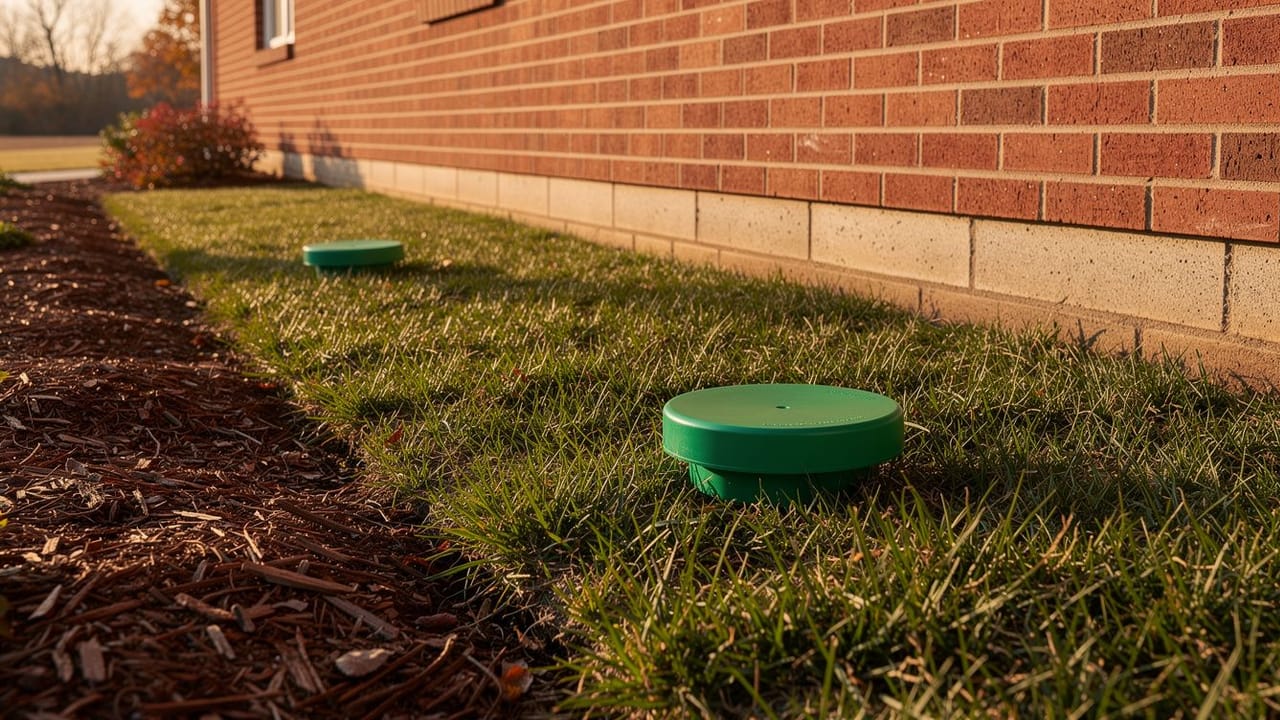
Baits use a very small amount of active ingredient inside tamper-resistant stations set in the ground. Kentucky’s Termite Baits: A Guide for Homeowners explains that workers eat the bait, share it with their nestmates, and die while molting within weeks of feeding. The slow action is the point, because it gives the workers time to pass the bait through the colony.
So these are two different tools, not one product in two forms. One keeps termites out of the soil next to the house; the other goes after the colony doing the feeding. That difference drives everything below, and it is why our termite treatment starts with an inspection of the house rather than a product choice.
How long does each take to stop termites?
A liquid barrier is in place the day the soil is treated, while a bait works on a timeline of months. NC State Extension’s guide to termite baiting systems says the effect of baits is not immediate and that reducing or eliminating a colony may take several months. Kentucky puts colony elimination at several months or longer and warns that some damage can happen before the bait takes effect.
There is a wait before that clock even starts. NC State is direct that nobody can predict how soon termites will find a station and feed in it, and that cold weather or drought can reduce foraging. Baits also do not lure termites in. They depend on foraging termites running into them, which is why the stations go in a ring roughly 2 to 4 feet out from the foundation and no more than 20 feet apart.
That timeline matters most when termites are already in the wood. If you are finding mud tubes or swarmers indoors (our post on termite signs in a Middle Tennessee home shows what each looks like), the real question is how long you can accept feeding while a bait works. Kentucky notes that some houses get baits combined with a partial liquid application, and that supplemental liquid may be warranted if termites keep returning.
When is bait the better choice for a house?
Bait is the better choice when getting liquid into the soil is difficult or restricted. NC State lists the cases: drains, ducts or slab construction that make access hard; a well or cistern near the house, where a standard soil treatment may be illegal; a foundation drain that could carry chemical out to a pond, creek or other water; or an owner who would simply rather not use one. That guidance is written for North Carolina, so on a house with a well we go by the product label for that specific job.
Several of those cases come up around here. Houses on the rural edges of the counties we cover, from Lebanon out to Columbia, may run on a well or a cistern, and some sit close to a pond or creek. Slab houses, and basements with an attached patio or garage, mean a liquid job involves drilling: Kentucky notes liquid treatment can mean injecting beneath concrete slabs through holes made with masonry drills. Baits avoid that drilling and the furniture moving that often comes with it.
Liquid tends to make more sense when the house is easy to treat, there is no water nearby to protect, and termites are active right now. Before we recommend either, we look at the grade, the slab or crawl space, any foundation drains, and whether there is a well on the property.
What does it take to keep either one working?
Both need a yearly commitment, and bait needs a bigger one. Kentucky’s homeowner answers say all liquid termiticides are supposed to control termites for at least five years, and that under the usual warranty the company returns and retreats affected areas at no additional charge, provided the annual renewal is maintained.
Bait stations have to be monitored and maintained on a schedule, with bait replaced as termites eat it. NC State estimates a baiting renewal is likely to cost two to four times what a liquid renewal does. Kentucky’s advice is to weigh that against the renewal fee on a liquid job, because once a bait contract lapses there is no residual pesticide left in the soil to protect the house.
Neither method is a guarantee. NC State says no chemical termite treatment will be 100 percent effective every time, and a house may need a conventional retreatment at some point. What protects you is the renewal terms in writing: what gets inspected, how often, and what the company does if termites come back. Our post on what a pest control contract should cover lists the terms worth checking. When you want the house looked at, tell us about it: slab, crawl space or basement, and whether it is on a well.
Sources
- University of Kentucky Entomology, ENTFACT-639, Termite Baits: A Guide for Homeowners (Potter, rev. 3/26) — How baits work and why they are slow; colony elimination can take several months or longer; large-volume liquid versus small-dose bait; no drilling with baits; combined and supplemental liquid; monitoring cost versus renewal fee; no residual protection when renewals stop
- University of Kentucky Entomology, ENTFACT-604, Termite Control: Answers for Homeowners (Potter, rev. 3/26) — Liquid barrier in the soil; liquids should control termites for at least five years; retreatment at no charge with annual renewal; slab injection with masonry drills
- NC State Extension, Termites: Baiting Systems (rev. 2020) — When baits fit (access, wells and cisterns, foundation drains, owner preference); station spacing; baits do not attract termites; months to work; unpredictable discovery; renewal likely 2x-4x a liquid renewal; no treatment 100% effective
FAQ
Termite Bait Stations or a Liquid Barrier? — questions
How long does it take termite bait to kill a colony?
Several months is typical, and it can run longer. Termites first have to find a station on their own, which slows down in cold weather or drought. Once they feed, the bait acts slowly on purpose so the workers share it with the rest of the colony, and the termites die as they molt.
How long does a liquid termite treatment last?
Liquid termiticides are meant to control termites for at least five years, according to University of Kentucky Entomology. Under the usual warranty the company returns and retreat affected areas at no extra charge if termites come back, as long as the annual renewal is kept up.
Can termite bait stations be used near a well or a foundation drain?
Yes, and that is one of the main reasons to choose them. A standard soil treatment can be restricted near a well or cistern, and a foundation drain can carry liquid termiticide toward a pond or creek. Baits use a very small amount of active ingredient held inside stations in the ground.
Do termite bait stations attract termites to the house?
No. NC State Extension says baits do not attract termites. They work only when foraging termites come across a station, which is why stations are set about 2 to 4 feet from the foundation and no more than 20 feet apart, so termites heading for the house are likely to hit one.
What happens if I stop paying the termite bait renewal?
The stations stop being checked and refilled, and the house loses its protection. Unlike a liquid barrier, a bait leaves no residual pesticide in the soil once it is gone. That is why the higher renewal cost of baiting is worth weighing before you choose it, not after the first year.