
· by Michael Blair, Nashville's Pest Control
When a house goes under contract, someone usually asks for “the termite letter,” often with a closing date already on the calendar. In Tennessee that letter is a Wood Destroying Insect Infestation Report, and it is narrower than most sellers and buyers assume. It records what a licensed inspector could see in, on and under the house on one day. It is not a structural opinion and it is not a promise about next spring. We write these reports as part of our termite inspection and treatment work, and the questions we hear most come from people who have never read one before. Here is what the report is, what it says, what it leaves out, and the one point where the state and the national form read differently.
What the letter actually is
The Tennessee Department of Agriculture’s pesticide consumer tips describe the report as one that is issued in conjunction with the sale or transfer of real estate. That tie to a sale is the whole reason the document exists. Nobody needs one to live in a house; they need one to buy, sell or finance it.
Not every company can write one. The department’s certification and licensing FAQ says these reports may only be issued by firms chartered to provide wood destroying organism treatments, and that the report goes on forms from the National Pest Control Association, with HUD named as the other source of forms. That FAQ page is older, so treat it as the department’s stated position rather than the full rule text. The consumer tips page adds a simple check: ask the applicator for a Commercial Pesticide Applicator Certification card or a Commercial Pesticide License card, and look for the charter number on the vehicle. Ask us for ours the same way you would ask anyone.
The form most people see is the NPMA-33. The NPMA’s guidelines for completing it say it must be used for HUD and VA guaranteed loans and is typically used for conventional ones, and that where a state mandates its own form, the state form takes over. The guide is also explicit that it does not override a state’s own inspection procedures.
What “no visible evidence” covers
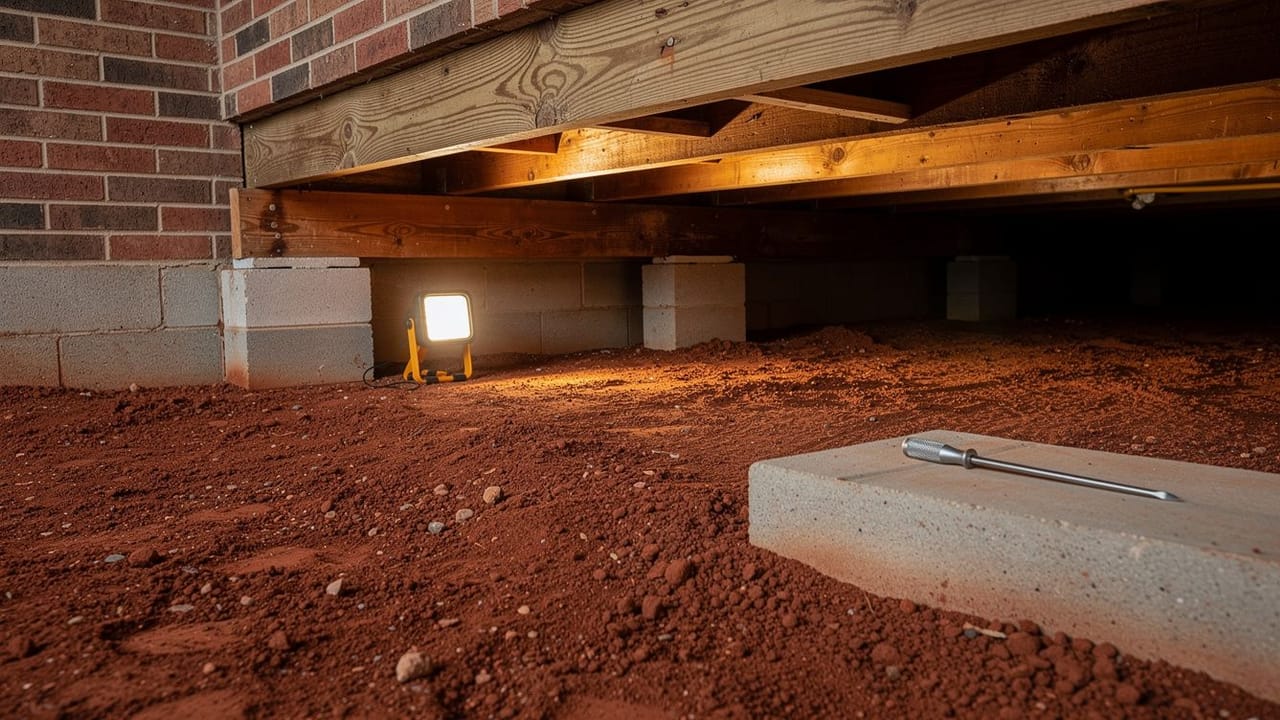
The word that matters on the report is visible. The NPMA-33 guidelines limit the inspector to visible evidence of wood destroying insects and visible damage in, on or under the structure. That includes crawl spaces, basements and porches, and an attached deck counts as part of the house. Mulch beds against the foundation, woodpiles, old stumps and the ground beneath decks and overhangs are not reported in that part of the form, even though they are often where a problem starts.
The same guide says the inspector probes and sounds wood that is readily accessible, and it is plain about the limits: the inspector is not a damage expert, does not separate structural damage from cosmetic damage, and hidden damage may be present. Questions about how serious damage is go to a qualified structural professional. So a finished basement with drywall over the sill, a crawl space packed with stored furniture, or a porch with no access underneath all leave wood the inspector cannot reach, and the report will say less about those spots.
For a seller, the useful step before the inspection is to make the crawl space hatch, the basement walls and the garage edges reachable. In the Nashville housing stock, where so many houses sit over a crawl space, that hatch is usually the first place we go. If you want the background on what termite activity looks like before anyone writes a report, our post on termite signs in a Middle Tennessee home covers mud tubes, swarmers and damaged wood.
When the inspector finds something
There is no partial pass. Per the NPMA guidelines, the no-visible-evidence box is checked only if there is none at all, past or present. Any visible evidence, regardless of how much or how old, goes in the other box. That evidence can be live insects, dead insects or their parts, frass, shelter tubes, exit holes, staining, or visible damage. A ten-year-old mud tube on a pier counts the same as a fresh one for that purpose.
What the report recommends depends on what was found and what paperwork exists, and the guide’s four cases are listed at the end of this section. Three of them are about whether treatment is recommended. The fourth is about timing.
The timing case is the one that catches sellers. If your termite paperwork turns up the week after the report is written, the report is not rewritten; the documentation goes to the lender and the parties alongside it. The time to find the treatment records, the bond or the service agreement is before the inspector arrives. If you are not sure what your current agreement actually covers, our post on what a pest control contract should cover walks through the terms worth checking.
- Live termites found: treatment or corrective action is recommended
- Evidence found with no documentation of treatment: treatment is recommended
- Evidence of a past infestation with documented treatment: treatment may still be recommended unless the house is under a warranty or service agreement
- Documentation produced after the report: the report stays as written and the paperwork goes to the lender and parties
The 90 days, and what to ask
This is where two sources read differently, and both are worth knowing in the words they use. The Tennessee Department of Agriculture’s consumer tips say the report must be warranted for ninety days as to the accuracy of the representations in it, and the department’s licensing FAQ says such reports are to be warrantied for 90 days. The NPMA-33 guidelines say the report describes conditions on the date of inspection only and carries no warranty unless an attachment to the report says so. We are not going to settle that here. Ask the firm writing your report, before it is written, what it stands behind and for how long, and get the answer on paper with the report.
Beyond that, a few questions sort out most surprises. Which areas were inaccessible, and why? Was anything found outside the structure that the form does not report, such as a stump by the foundation or mulch piled against the siding? If evidence was found, is treatment recommended, and what documentation would change that? And if you are the buyer, remember the report is not a structural opinion; damage questions go to someone qualified to judge the framing.
If a report or a treatment is not handled the way it should be, the department takes pesticide complaints directly. We write reports for sales across Nashville and Davidson County and the towns around it. If you are under contract and need a termite letter, send us the address and your closing date, and tell us what access the crawl space or basement has so we can plan the visit.
Sources
- Tennessee Department of Agriculture, Pesticide Consumer Tips — The Wood Destroying Insect Infestation Report is issued with the sale or transfer of real estate and must be warranted for ninety days as to accuracy; ask for the certification or license card; charter number on the vehicle
- Tennessee Department of Agriculture, Certification, Licensing and Charters — Reports issued only by chartered firms, on National Pest Control Association or HUD forms; reports are to be warrantied for 90 days
- Tennessee Department of Agriculture, Pesticide Complaints — Where pesticide complaints go in Tennessee
- NPMA, Suggested Guidelines for Completing the Wood Destroying Insect Inspection Report (NPMA-33), v1.3, 2019 — Form use for HUD, VA and conventional loans; visible evidence only; what counts as evidence; inspector is not a damage expert; conditions on the inspection date only, no warranty unless attached; treatment recommendations and late documentation