· by Michael Blair, Nashville's Pest Control
A noise over the bedroom ceiling or inside a wall at two in the morning sends a lot of people up the attic ladder with a flashlight. Before you go, it helps to know that the five animals behind most of these noises in Middle Tennessee, mice, rats, squirrels, raccoons and bats, keep different hours, make different sounds and need very different removal. A mouse is a trapping and sealing job. A raccoon is a wildlife job with a mother and young to think about. A bat colony cannot legally be shut out in Tennessee until the state signs off. Working out which one you have comes first, and it is mostly a matter of when you hear it and what it leaves behind.
When you hear it narrows the list
Night noise points first to rodents. The extension chapter on house mice calls them mainly nocturnal and describes what people hear: gnawing, climbing inside walls, running across the top of the ceiling, and squeaks. UC IPM’s rat notes say rats are mostly active at night too, and that roof rats in particular nest in attics and wall voids. In our experience a rat is the heavier of the two, a single run with a thump at the end, where mice sound like light, quick ticking that starts and stops.
Gray squirrels keep the opposite schedule. Connecticut’s wildlife agency describes gnawing, scratching and pattering in early morning or daylight hours, and Alabama Extension adds the rustling of nest material being dragged around. Noise at first light and again before dusk, quiet at midnight, is a squirrel pattern. Flying squirrels are the exception in our experience: they are the squirrel we hear after dark, and the same Connecticut page notes they get in through much smaller holes than gray squirrels use.
TWRA describes the raccoon as nocturnal, and what we hear from one is not scratching so much as weight: heavy walking, thuds, sometimes a low churring from young in spring. Bats are the quietest of the five. What people usually notice from our side is faint squeaking or rustling near a gable or soffit around dusk, when the colony leaves to feed, rather than anything moving overhead in the middle of the night.
Droppings and the size of the hole
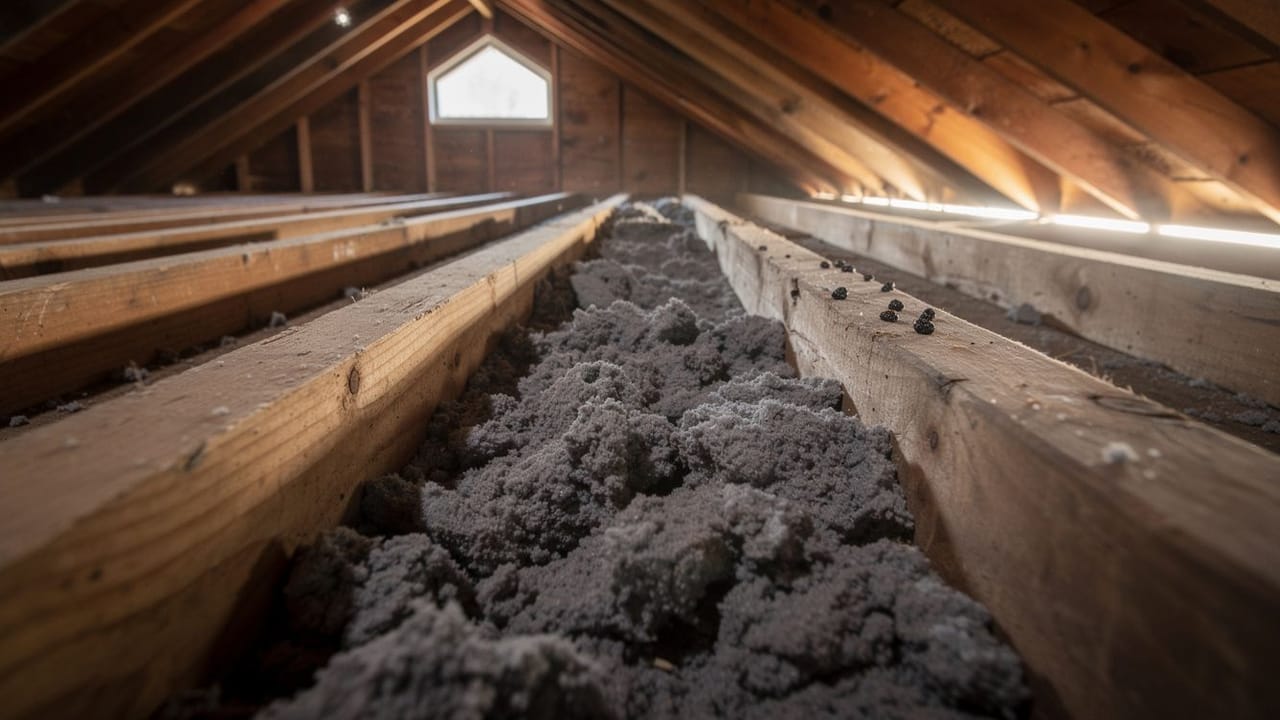
Mouse droppings run about a quarter inch long, per the house mouse chapter, and they are scattered along runs rather than piled. Bat droppings can look similar at a glance, but the same chapter points out that they contain insect fragments and crush easily. Roll one under a gloved finger: a rodent pellet stays hard, a bat pellet crumbles into shiny bits. Bat droppings also collect in a pile under the spot where the colony hangs or gets in, often below a ridge vent or gable end.
The gap sizes are smaller than most people expect. The mouse chapter says to seal every opening larger than a quarter inch, and UC IPM gives the same quarter inch for rats. The half-inch number you may have read is from UC IPM too, but it is the gap under a door that a young rat can get past, not the size of a hole in the house. UC IPM also lists what rats gnaw through: plastic, foam, wood and caulk, so a gap stuffed with spray foam is a delay rather than a seal. The full mouse-proofing approach is in our post on keeping mice out of a Nashville house.
Squirrels and raccoons open the house up instead of slipping through. Connecticut’s squirrel page lists the usual spots as holes around dormers, ridge vents, eaves and attic vents, which matches what we find on Middle Tennessee rooflines where a soffit has softened from years of gutter overflow. A chewed, rounded hole at the eave with gnaw marks is squirrel work. A torn vent cover or a soffit panel pulled down is usually a raccoon. For bats, Delaware’s bat exclusion guidance notes that a bat needs only an eighth of an inch to get back in, which is why bat work means sealing seams that look closed.
How each one comes out
Mice and rats come out by trapping and sealing together, which is the core of our rodent removal and exclusion work. Squirrels, raccoons and bats are handled through our wildlife removal service, and the method there is exclusion: let the animal leave on its own, then close the way back in. Alabama Extension recommends one-way doors for squirrels and notes they breed in February and March and again in July and August, with young staying in the nest ten to twelve weeks. A one-way door on a nest full of young leaves them inside, so we look before we close anything.
Raccoons follow the same logic. TWRA’s raccoon page advises waiting until the young leave and closing all but one exit, and says relocating a raccoon requires a permit from the agency. TWRA’s wildlife damage control page says the same for moving and releasing live wildlife generally and requires operators to check their traps within 36 hours.
Bats are the one homeowners most often get wrong. That TWRA page states that the agency requires approval before any bat exclusion work, with the species, the number of bats and whether young are present. TWRA does not publish a set of exclusion dates on that page, so we do not quote one. Delaware’s guidance, written for Delaware and not Tennessee, shows why timing matters: it keeps one-way devices in place five to seven days and avoids its maternity window of May 15 to August 31, when flightless pups would be sealed inside.
- Mice and rats: snap traps in the runs, then every opening over a quarter inch sealed with material they cannot chew
- Squirrels: one-way door on the entry after checking for young, then the hole repaired
- Raccoons: wait for the young to leave, one exit left open, then closed
- Bats: TWRA approval first, then one-way devices and sealing
Cleaning up what they leave
The cleanup is where people put themselves at risk. The CDC’s rodent cleanup guidance says not to vacuum or sweep rodent urine, droppings or nesting material, because it puts the dust in the air. Instead, soak it with a bleach solution of one and a half cups of bleach per gallon of water, let it sit five minutes, and wipe it up. Where insulation is soaked with urine and droppings, the CDC says to bag it in plastic for removal, and for a heavy infestation it calls for a HEPA respirator. In a Middle Tennessee attic in summer that work is hot, slow and best done after the animals are confirmed gone.
Bat droppings carry their own concern. The CDC’s histoplasmosis prevention page says large amounts should be cleaned up by a company that specializes in hazardous waste, and NIOSH lists removing the bats, controlling dust and wearing respiratory and eye protection. Before anyone pulls insulation in an older house, check what it is. Loose, pebbly, gray-brown or gold insulation may be vermiculite, and the EPA advises leaving it undisturbed and having it removed only by an accredited asbestos contractor.
If something is moving over your ceiling tonight, write down when you hear it and what it sounds like, and do not seal the hole you find until you know whether anything is still inside. Then ask us for a free estimate and we will look at the roofline, the attic and the droppings and tell you which animal it is.
Sources
- Timm, House Mice (Prevention and Control of Wildlife Damage, 1994), Maine DACF copy — Mice are mainly nocturnal; the sounds they make; quarter-inch droppings and openings; bat droppings contain insect fragments
- UC IPM, Rats Pest Notes — Rats mostly active at night; roof rats in attics and wall voids; seal openings over a quarter inch; half-inch door gap for young rats; materials rats gnaw
- Alabama Cooperative Extension, Eastern Gray Squirrels: Managing and Preventing Attic Damage — Rustling sounds, one-way doors, breeding seasons and how long young stay
- Connecticut DEEP, Problems with Squirrels — Gray squirrel sounds in early morning and daylight; flying squirrel entry points
- Tennessee Wildlife Resources Agency, Raccoon — Raccoons are nocturnal; wait for young to leave; relocation requires a TWRA permit
- Tennessee Wildlife Resources Agency, Wildlife Damage Control in Tennessee — TWRA approval required before bat exclusion; permits for moving live wildlife; traps checked within 36 hours
- Delaware DNREC, Best Management Practices for Bat Exclusions (2010) — Delaware guidance: one-way devices five to seven days, eighth-inch re-entry gap, Delaware maternity window
- CDC, How to Clean Up After Rodents — No vacuuming or sweeping; bleach solution and soak time; bagging contaminated insulation; HEPA respirator
- CDC, Preventing Histoplasmosis — Large amounts of droppings cleaned by a hazardous waste company
- NIOSH, Preventing Histoplasmosis — Removing bats, dust control, respiratory and eye protection
- EPA, My attic has vermiculite insulation in it — Leave vermiculite undisturbed; removal by an accredited asbestos contractor