· by Michael Blair, Nashville's Pest Control
The question people ask most when a technician is booked is how long the family and the dog have to stay out afterward. The honest answer is that it depends on the product, and the product’s label says how long. There is no general number of hours that holds for every treatment, and a figure you read online may be for something we are not using. Here is what EPA and the National Pesticide Information Center say to do before, during and after a treatment, and what to ask for so you know the wait for your house. The visits themselves are our general pest control service.
How long should you wait after pest control spray?
How long to wait after a pest control spray is set by the label of the product applied, and at the least until the spray has dried. EPA’s tips for selecting a pest control service say not to let children or pets into treated areas until the spray is dry. EPA’s older Citizen’s Guide to Pest Control and Pesticide Safety, kept in the agency’s archive, puts it in terms of the label: keep people away from treated areas for at least the time the label prescribes, and if the label allows it, open the windows and run fans afterward.
That is why we do not quote one waiting time for every visit. A bait gel in a cabinet hinge, a spray along the outside foundation and a dust in a wall void are different products with different instructions. Before we start, we tell you which ones we are using and what each label says about re-entry, so the wait you follow is the one written for that product.
What happens to pets and fish tanks during a treatment?
Pets and fish tanks are moved or covered during a treatment, and the label decides when pets come back. The National Pesticide Information Center’s fact sheet on pets and pesticide use says to take pets out of the house during indoor applications or keep them in rooms that are not being treated, and to keep them off treated areas for the time the label specifies. It also says to pick up pet toys, bedding and food and water bowls from the area first.
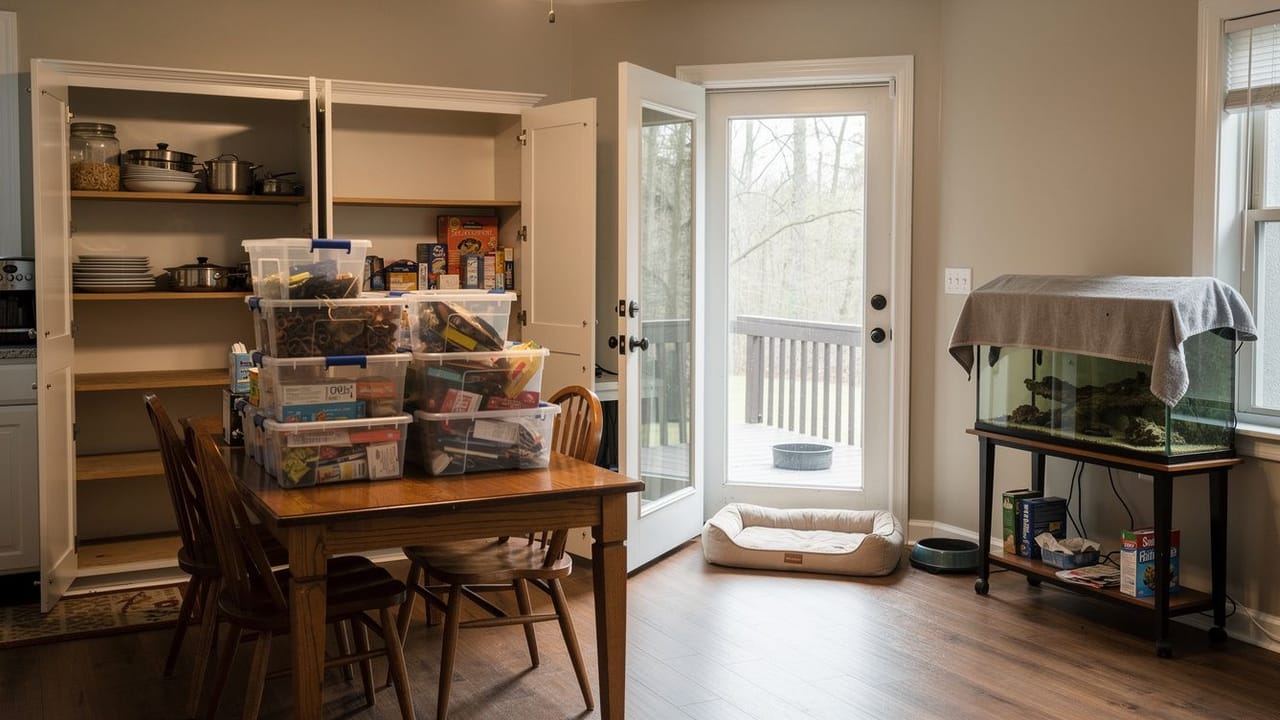
Fish need their own step. NPIC says to cover tanks so vapors or dusts cannot get into the water, and EPA’s tips say to remove aquariums or cover them with the air pump switched off. The Citizen’s Guide lists birds and fish along with dogs and cats among the pets to keep away. Cages and pet beds go to an untreated room or outside until the label’s time has passed.
What has to come out of the kitchen before a treatment?
Food, dishes, pots and pans have to come out of any kitchen cabinet that is being treated. The Citizen’s Guide says to clear them before cabinets are treated, keep pesticide off food preparation surfaces, wait until shelves are dry before putting things back, and wash any surface that may carry residue before food goes on it.
In practice that means emptying each cabinet on the treatment plan, including the one under the sink, and setting the contents in another room or in closed bins. Counters stay clear. When we are done we tell you which areas were treated so you know which shelves to let dry and which surfaces to wash before you cook. For roaches in particular, our post on big and small roaches explains why the kitchen is usually where the work is.
What should you ask the company before treatment day?
Ask the company for the label of every product it will use, and the rate it will apply it at. EPA’s tips name both, and the label is where the re-entry time, the pet instructions and the ventilation advice live. The Citizen’s Guide adds that a company’s plan should include the active ingredients, any non-chemical options, and special steps to cut your exposure, such as leaving the house, emptying cupboards or moving pets.
EPA also says every pest control company needs at least one certified, licensed commercial applicator, and that licenses can be checked with the state department of agriculture, which in Tennessee is the Department of Agriculture. What separates an exterminator from a pest control company goes further into who holds that license. We treat homes in Murfreesboro, Nashville and across Middle Tennessee; to see the labels before you book, ask us for a free estimate.
Sources
- U.S. EPA, Tips for Selecting a Pest Control Service — Children and pets out of treated areas until the spray has dried; remove pets; remove or cover aquariums and turn off the air pump; ask for labels and application rates; a certified, licensed applicator; licenses checked with state departments of agriculture.
- U.S. EPA, Citizen’s Guide to Pest Control and Pesticide Safety (archived) — Stay away from treated areas for at least the label time; ventilate if the label permits; clear food and dishes from cabinets, let shelves dry, wash surfaces; birds and fish among pets; ask for a plan with active ingredients, non-chemical options and exposure steps.
- National Pesticide Information Center, Pets and Pesticide Use — Remove pets during indoor applications or keep them in untreated areas; keep them off treated areas for the label time; remove toys, bedding and bowls; cover fish tanks.
FAQ
How Long to Stay Out After a Pest Control Treatment — questions
How long after pest control can kids go back inside?
As long as the product label says, and for a spray at least until it has dried, which is EPA’s baseline for children and pets. There is no single number of hours for every treatment, because each product carries its own re-entry instructions. Ask the company for the labels before the visit so you know the wait.
Is pest control safe for pets?
It depends on the product and on following its label. The National Pesticide Information Center says to remove pets from the house during indoor treatments or keep them in untreated rooms, pick up their bowls, toys and bedding first, and keep them off treated areas for the time the label specifies. Ask to see the labels.
Should I cover my fish tank during pest control?
Yes. The National Pesticide Information Center says to cover tanks so vapors or dusts cannot get into the water, and EPA says to remove aquariums or cover them and turn the air pump off. Leave the cover on until the treated area has dried and the label’s re-entry time has passed.
Do I have to remove dishes before pest control?
From any cabinet being treated, yes. EPA’s Citizen’s Guide says to take out food, pots, pans and dishes first, wait until the shelves dry before putting them back, and wash any surface that may carry residue before food goes on it. Closed bins in another room keep everything clean meanwhile.
Do I need to leave the house during pest control?
Sometimes. EPA’s Citizen’s Guide says to stay away from treated areas for at least the time on the label, and some treatments call for leaving the house entirely while others only close off certain rooms. The product label decides, so ask the company which products it is using before the day of the visit.
Can I wipe down surfaces after pest control?
Wash food preparation surfaces that may have residue before food touches them, as EPA’s Citizen’s Guide advises, and let treated shelves dry before refilling them. For other surfaces, ask the technician what was applied there and follow that product’s label rather than a general habit of wiping everything down.